Dilbert cartoon first published on Wednesday 31st January 1996
Dilbert//2482, first published thirty years ago on Wednesday 31st January 1996
Tags
critical code air traffic control gifted programmer payroll system dont fly pay day
Official transcript
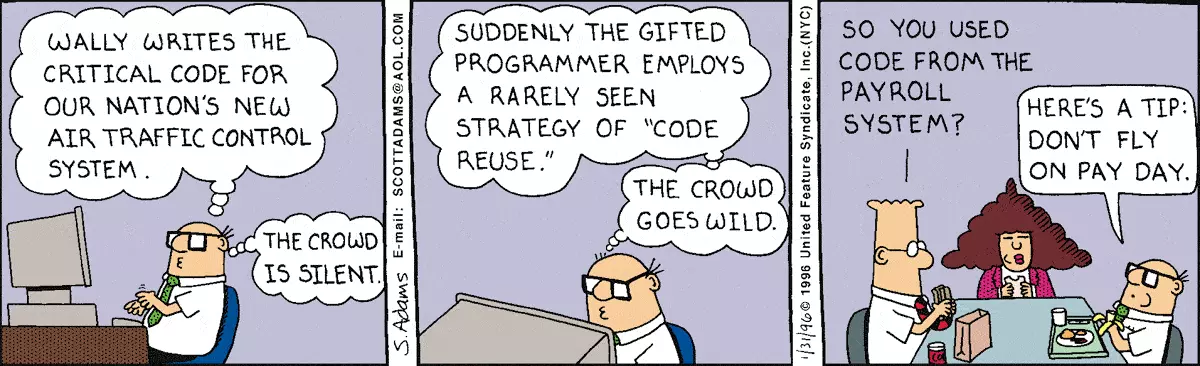
Wally sits at his desk and thinks, "Wally writes the critical code for our nation's new air traffic control system. The crowd is silent."
Wally thinks, "Suddenly the gifted programmer employs a rarely seen strategy of 'code reuse.' The crowd goes wild."
Dilbert, Wally and Alice sit a table eating lunch. Dilbert asks Wally, "So you used code from the payroll system?"
Wally replies, "Here's a tip: don't fly on pay day."
originally published on dilbert.com
Open source transcript
WALLY WRITES THE CRITICAL CODE FOR OUR NATION'S NEW AIR TRAFFIC CONTROL SYSTEM.
THE CROWD IS SILENT.
SUDDENLY THE GIFTED PROGRAMMER EMPLOYS A RARELY SEEN STRATEGY OF "CODE REUSE." THE CROWD GOES WILD.
SO YOU USED CODE FROM THE PAYROLL SYSTEM?
HERE'S A TIP: DONT FLY ON PAY DAY.
collated from github.com/jvarn/dilbert-archive
AI Analysis
Comic Strip Title: "Code Reuse"
Summary:
The comic strip revolves around a conversation between Wally and Dilbert in a workplace setting. The scene unfolds as follows:
- Wally proudly announces that he has written a critical code for the nation's new air traffic control system.
- Dilbert, however, is unimpressed and remarks that the crowd is silent, implying that Wally's achievement is not being recognized or appreciated.
- Wally responds by revealing that he employed a rarely seen strategy of "code reuse" to achieve his goal.
- Dilbert inquires about the code used from the payroll system, and Wally explains that he used code from the payroll system.
- Dilbert then asks if Wally used code from the payroll system, to which Wally responds with a humorous remark, "Here's a tip: don't fly on pay day."
Key Takeaways:
- The comic strip pokes fun at the idea of code reuse and the potential consequences of using code from other systems without proper consideration.
- It also highlights the humorous side of workplace interactions and the creative ways in which employees might try to get attention or recognition for their work.
generated by llama-3.2-11b-vision-instruct
Accompanying textual content, such as title, tags and transcripts, is shown here if we have it. Not every comic has all of these, and they seem to be a bit hit and miss even on the official website.