Dilbert cartoon first published on Wednesday 10th April 1996
Dilbert//2552, first published thirty years ago on Wednesday 10th April 1996
Tags
catbert hr director went nuts vending machine offer counseling more economical death penalty possible microwave oven
Official transcript
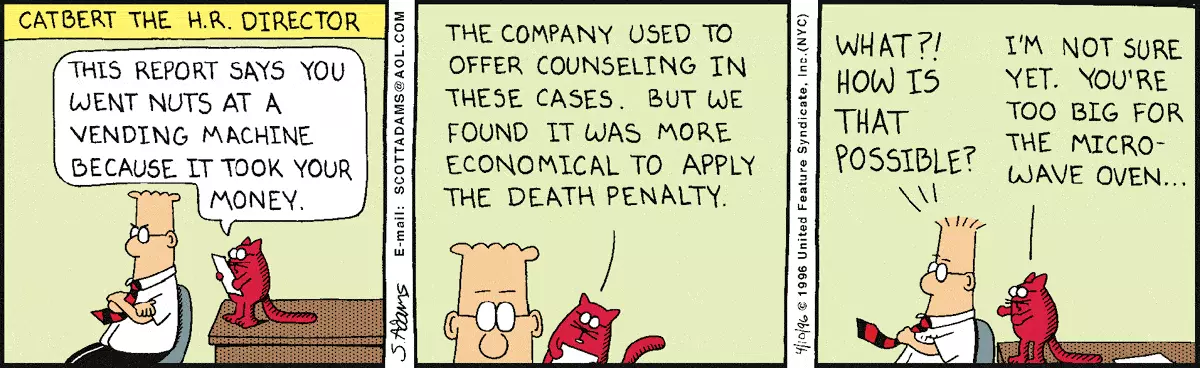
Catbert says to Dilbert, "This report says you went nuts at a vending machine because it took your money."
Dilbert sits with his arms crossed over his chest. Catbert continues, "The company used to offer counseling in these cases. But we found it was more economical to apply the death penalty."
Dilbert looks shocked. Dilbert asks, "What?! How is that possible?"
Catbert replies, "I'm not sure yet. You're too big for the microwave oven . . ."
originally published on dilbert.com
Open source transcript
CATBERT THE H.R. DIRECTOR THIS REPORT SAYS YOU WENT NUTS AT A VENDING MACHINE BECAUSE IT TOOK YOUR MONEY.
THE COMPANY USED TO OFFER COUNSELING IN THESE CASES. BUT WE FOUND IT WAS MORE ECONOMICAL TO APPLY THE DEATH PENALTY.
WHAT?!
HOW IS THAT POSSIBLE?
I'M NOT SURE YET. YOU'RE TOO BIG FOR THE MICROWAVE OVEN...
collated from github.com/jvarn/dilbert-archive
AI Analysis
Comic Strip Title: "Death Penalty"
This comic strip, originally published in 1998, features the main character, Dilbert, engaging in a conversation with his boss, Catbert, who is the H.R. Director. The strip begins with Catbert presenting Dilbert with a report that reveals he spent money at a vending machine because it took his money. Catbert then informs Dilbert that the company used to offer counseling in these cases but found it was more economical to apply the death penalty.
Key Elements:
- Setting: The scene is set in an office environment, with Dilbert and Catbert seated at a desk.
- Characters:
- Dilbert: The main character, a white male with a distinctive appearance.
- Catbert: The H.R. Director, a red cat-like creature with a menacing demeanor.
- Plot:
- Catbert presents Dilbert with a report detailing his spending habits.
- Catbert reveals that the company used to offer counseling but found it more cost-effective to apply the death penalty instead.
- Humor:
- The use of a vending machine as a source of trouble for Dilbert.
- The absurdity of applying the death penalty as a punishment.
- Themes:
- The consequences of one's actions.
- The humorous and satirical take on corporate culture and bureaucracy.
generated by llama-3.2-11b-vision-instruct
Accompanying textual content, such as title, tags and transcripts, is shown here if we have it. Not every comic has all of these, and they seem to be a bit hit and miss even on the official website.


