Dilbert cartoon first published on Tuesday 14th November 1989
Dilbert//213, first published 37 years ago on Tuesday 14th November 1989
Tags
dilbert dogbert writing affirmations thoery objective achieved garden slug
Official transcript
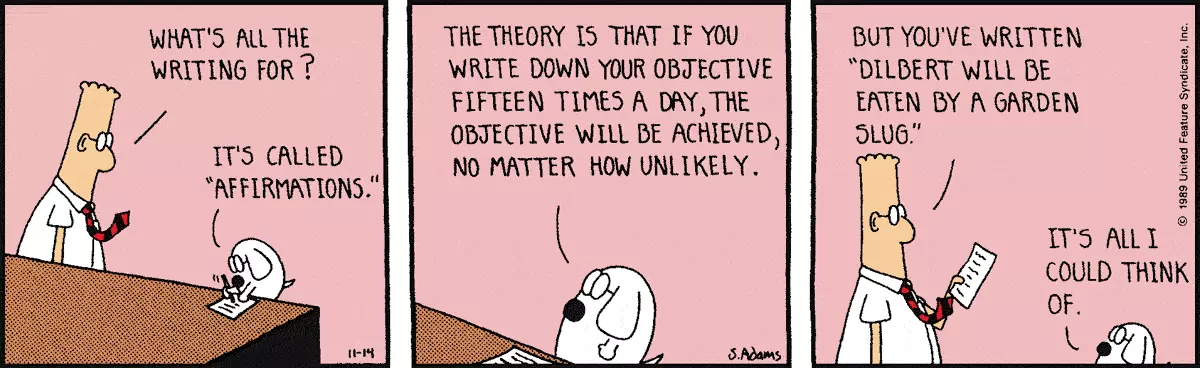
Dogbert stands at a desk writing on a piece of paper. Dilbert asks, "What's all the writing for?"
Dogbert replies, "It's called 'affirmations.'"
Dogbert explains, "The theory is that if you write down your objective fifteen times a day, the objective will be achieved, no matter how unlikely."
Dilbert reads the affirmation and says, "But you've written 'Dilbert will be eaten by a garden slug.'"
Dogbert replies, "It's all I could think of."
originally published on dilbert.com
Open source transcript
WHAT'S ALL THE WRITING FOR?
IT'S CALLED "AFFIRMATIONS." THE THEORY IS THAT IF YOU WRITE DOWN YOUR OBJECTIVE FIFTEEN TIMES A DAY, THE OBJECTIVE WILL BE ACHIEVED, NO MATTER HOW UNLIKELY.
BUT YOU'VE WRITTEN "DILBERT WILL BE EATEN BY A GARDEN SLUG." IT'S ALL I COULD THINK OF.
collated from github.com/jvarn/dilbert-archive
AI Analysis
The comic strip is titled "Affirmations" and features Dilbert, a white office worker with a black dot for a nose, who is sitting at his desk with a piece of paper in his hand. He is speaking to his boss, who is standing behind him, about the concept of affirmations.
Key Points:
- The boss explains that affirmations are a way to write down positive statements to help achieve goals.
- Dilbert is skeptical and points out that the theory is that if you write down your objective fifteen times a day, the objective will be achieved, no matter how unlikely.
- He then reveals that he has written "Dilbert will be eaten by a garden slug" and wonders if it's possible.
Humor:
- The comic strip is humorous because it pokes fun at the idea of affirmations and the idea that simply writing down a goal will make it come true.
- The punchline about the garden slug adds to the humor, as it is an absurd and unlikely scenario.
Overall:
- The comic strip is a lighthearted commentary on the idea of affirmations and the power of positive thinking.
- It uses humor to highlight the limitations of this approach and the importance of realistic goal-setting.
generated by llama-3.2-11b-vision-instruct
Accompanying textual content, such as title, tags and transcripts, is shown here if we have it. Not every comic has all of these, and they seem to be a bit hit and miss even on the official website.


