Dilbert cartoon first published on Thursday 17th October 1991
Dilbert//915, first published 35 years ago on Thursday 17th October 1991
Tags
dilbert dogbert democracy movement charismatic leader elbonian elbonia acne men trick question
Official transcript
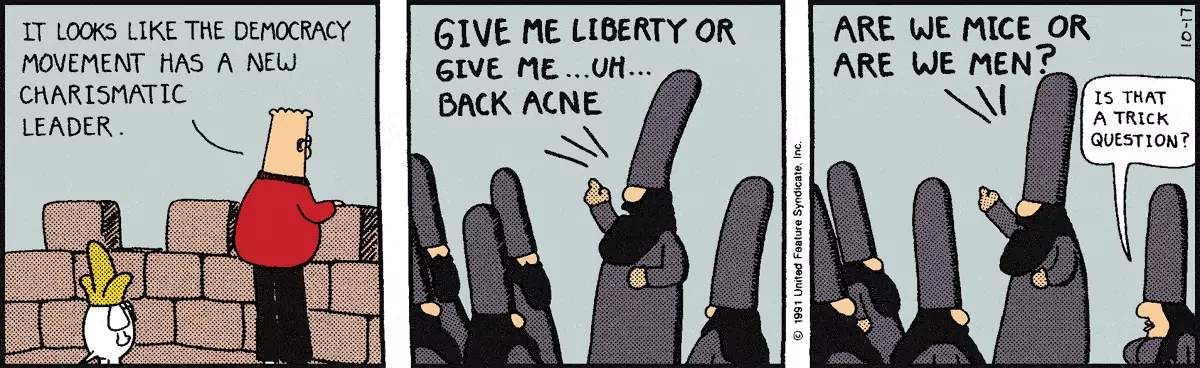
Dogbert and Dilbert stand on a castle turret. Dilbert looks over the edge and says, "It looks the democracy movement has a new charismatic leader."
A man stands in front of a crowd of Elbonians. The man yells, "Give me liberty or give me . . . Uh . . . Back acne."
The man yells, "Are we mice or are we men?"
An Elbonian woman asks, "Is that a trick question?"
originally published on dilbert.com
Open source transcript
IT LOOKS LIKE THE DEMOCRACY MOVEMENT HAS A NEW CHARISMATIC LEADER.
GIVE ME LIBERTY OR GIVE ME...UH...
BACK ACNE ARE WE MICE OR ARE WE MEN?
IS THAT A TRICK QUESTION?
collated from github.com/jvarn/dilbert-archive
AI Analysis
Comic Strip Title: "The Democracy Movement"
Summary:
The comic strip, originally published in 1991, presents a satirical commentary on the concept of democracy and its perceived flaws. The story unfolds in three panels:
- Panel 1: A man, representing a democratic leader, stands in front of a brick wall, symbolizing the foundation of democracy. He remarks, "It looks like the democracy movement has a new charismatic leader." This sets the tone for the narrative, hinting at the potential for a new direction in democratic leadership.
- Panel 2: The man is shown with his hand raised, addressing a crowd of people wearing gray robes and masks, reminiscent of the Ku Klux Klan. He asks, "Give me liberty or give me... uh... back acne." This unexpected twist introduces a sense of irony and humor to the scene.
- Panel 3: The crowd responds by asking, "Are we mice or are we men?" The man replies, "Is that a trick question?" This exchange highlights the absurdity of the situation, where the crowd is questioning their own identity and the nature of their existence.
Overall:
The comic strip uses humor and satire to critique the idea of democracy and its potential for manipulation. By depicting a democratic leader in a humorous and unexpected situation, the creator pokes fun at the notion of democratic leadership and the potential for individuals to be swayed by charismatic figures. The use of the Ku Klux Klan imagery adds an element of irony and social commentary, highlighting the complexities and challenges of democratic governance.
generated by llama-3.2-11b-vision-instruct
Accompanying textual content, such as title, tags and transcripts, is shown here if we have it. Not every comic has all of these, and they seem to be a bit hit and miss even on the official website.


