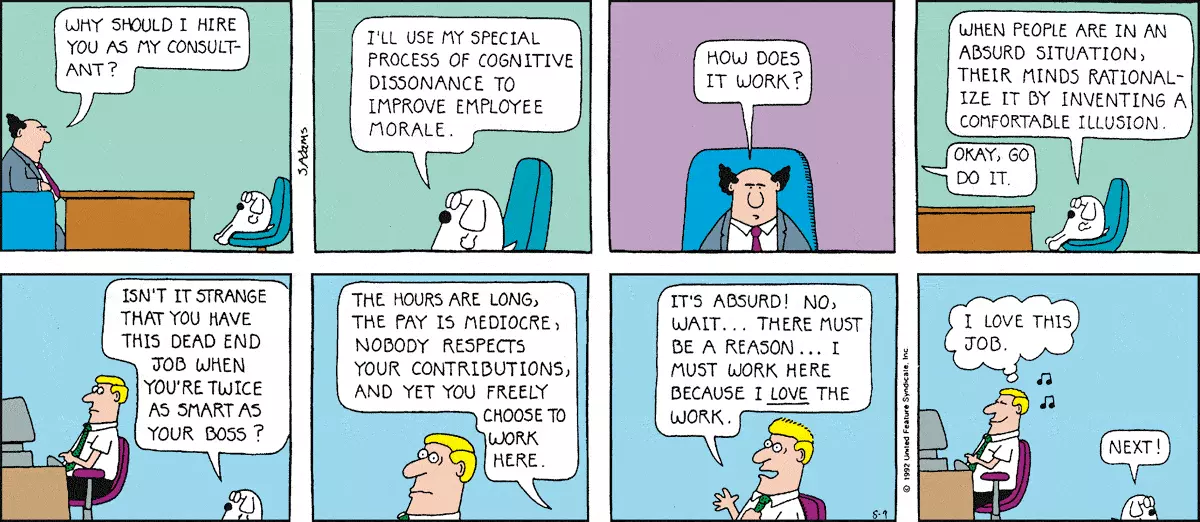
Dilbert cartoon first published on Sunday 9th August 1992
Dilbert//1212, first published 34 years ago on Sunday 9th August 1992
Tags
dogbert the boss hire consultant cognitive dissonance employee morale absurd situation work minds comfortable illusion strange dead end job love mediocre freely
Official transcript
Dogbert sits across from the Boss's desk. The Boss says, "Why should I hire you as my consultant?"
Dogbert replies, "I'll use my special process of cognitive dissonance to improve employee morale."
The Boss asks, "How does it work?"
Dogbert explains, "When people are in an absurd situation, their minds rationalize it by inventing a comfortable illusion."
The Boss says, "Okay, go do it."
Dogbert asks an employee, "Isn't it strange that you have this dead end job when you're twice as smart as your boss?"
Dogbert continues, "The hours are long, the pay is mediocre, nobody respects your contributions, and yet you freely choose to work here."
The man looks upset. The man says, "It's absurd! No, wait . . . There must be a reason . . . I must work here because I LOVE the work."
The man sits at his desk humming and thinking, "I love this job."
Dogbert says, "Next!"
originally published on dilbert.com
Open source transcript
WHY SHOULD I HIRE YOU AS MY CONSULTANT ?
I'LL USE MY SPECIAL PROCESS OF COGNITIVE DISSONANCE TO IMPROVE EMPLOYEE MORALE.
HOW DOES IT WORK?
WHEN PEOPLE ARE IN AN ABSURD SITUATION, THEIR MINDS RATIONALIZE IT BY INVENTING A COMFORTABLE ILLUSION.
OKAY, GO DO IT.
ISN'T IT STRANGE THAT YOU HAVE THIS DEAD END JOB WHEN YOU'RE TWICE AS SMART AS YOUR BOSS?
THE HOURS ARE LONG, THE PAY IS MEDIOCRE, NOBODY RESPECTS YOUR CONTRIBUTIONS, AND YET YOU FREELY CHOOSE TO WORK HERE.
IT'S ABSURD! NO, WAIT... THERE MUST BE A REASON... I MUST WORK HERE BECAUSE I LOVE THE WORK.
I LOVE THIS JOB.
NEXT!
collated from github.com/jvarn/dilbert-archive
AI Analysis
Title: "Cognitive Dissonance"
Summary:
The comic strip, originally published in 1997, features Dilbert, a bespectacled white dog, as the main character. The story begins with a conversation between Dilbert and his boss, who is seeking to hire a consultant to improve employee morale. Dilbert's response is a clever play on words, using his special process of cognitive dissonance to justify the absurdity of the situation.
The conversation unfolds as follows:
- Dilbert's boss asks why he should hire a consultant.
- Dilbert responds that he will use his special process of cognitive dissonance to improve employee morale.
- The boss asks how it works.
- Dilbert explains that when people are in an absurd situation, their minds rationalize it by inventing a comfortable illusion.
- The boss is skeptical, but Dilbert assures him that it's absurd, so there must be a reason to love the work.
- The boss is convinced and decides to hire Dilbert as his consultant.
Throughout the conversation, Dilbert's clever wordplay and wit are on full display, making for a humorous and entertaining comic strip. The strip pokes fun at the absurdity of corporate culture and the ways in which people can rationalize and justify even the most illogical situations. Overall, "Cognitive Dissonance" is a classic example of Dilbert's signature humor and satire.
generated by llama-3.2-11b-vision-instruct
Accompanying textual content, such as title, tags and transcripts, is shown here if we have it. Not every comic has all of these, and they seem to be a bit hit and miss even on the official website.