Dilbert cartoon first published on Sunday 4th October 1992
Dilbert//1268, first published 34 years ago on Sunday 4th October 1992
Tags
dilbert dogbert smart good-looking objective hypothetical talented qualities annoy dog sarcasm
Official transcript
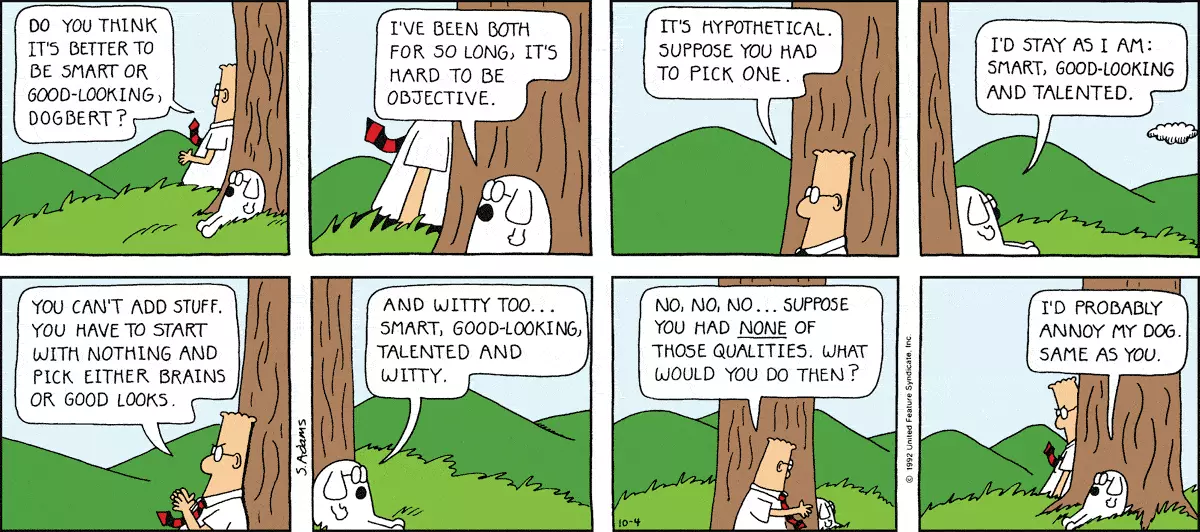
Dilbert and Dogbert sit under a tree. Dilbert asks, "Do you think it's better to be smart or good-looking, Dogbert?"
Dogbert replies, "I've been both for so long, it's hard to be objective."
Dilbert says, "It's hypothetical. Suppose you had to pick one."
Dogbert replies, "I'd stay as I am: smart, good-looking and talented."
Dilbert says, "You can't add stuff. You have to start with nothing and pick either brains or good looks."
Dogbert continues, "And witty too . . . Smart, good-looking, talented and witty."
Dilbert says, "No, no, no . . . Suppose you had NONE of those qualities. What would you do then?"
Dogbert replies, "I'd probably annoy my dog, same as you."
originally published on dilbert.com
Open source transcript
DO YOU THINK IT'S BETTER TO BE SMART OR GOOD-LOOKING, DOGBERT?
I'VE BEEN BOTH FOR SO LONG, IT'S HARD TO BE OBJECTIVE.
IT'S HYPOTHETICAL.
SUPPOSE YOU HAD TO PICK ONE I'D STAY AS I AM: SMART, GOOD-LOOKING AND TALENTED.
YOU CAN'T ADD STUFF.
YOU HAVE TO START WITH NOTHING AND PICK EITHER BRAINS OR GOOD LOOKS.
AND WITTY TOO...
SMART, GOOD-LOOKING, TALENTED AND WITTY.
NO, NO, NO... SUPPOSE YOU HAD NONE OF THOSE QUALITIES. WHAT WOULD YOU DO THEN?
I'D PROBABLY ANNOY MY DOG.
SAME AS YOU.
collated from github.com/jvarn/dilbert-archive
AI Analysis
The comic strip is titled "I'd Stay As I Am: Smart, Good-Looking and Talented."
Summary
The comic strip features Dilbert, a bespectacled man with a dog-like appearance, engaging in a conversation with Dogbert, a white dog with a black nose. The conversation revolves around the idea that being smart, good-looking, and talented is not enough to make one happy.
Key Points
- Dilbert expresses his desire to be smart, good-looking, and talented, but realizes that it's not enough to make him happy.
- Dogbert suggests that Dilbert's current qualities are sufficient, and that he should be content with who he is.
- Dilbert is skeptical, but eventually comes to accept Dogbert's advice.
- The comic strip pokes fun at the idea that people often strive for more than they need, and that true happiness can be found in being content with one's current state.
Overall
The comic strip is a humorous commentary on the human desire for perfection and the importance of being content with oneself. It encourages readers to appreciate their own unique qualities and not strive for something that may not bring them true happiness.
generated by llama-3.2-11b-vision-instruct
Accompanying textual content, such as title, tags and transcripts, is shown here if we have it. Not every comic has all of these, and they seem to be a bit hit and miss even on the official website.


