Dilbert cartoon first published on Monday 31st July 1995
Dilbert//2298, first published 31 years ago on Monday 31st July 1995
Tags
i think therefore i am philosophical question you're not me you're irrelevant
Official transcript
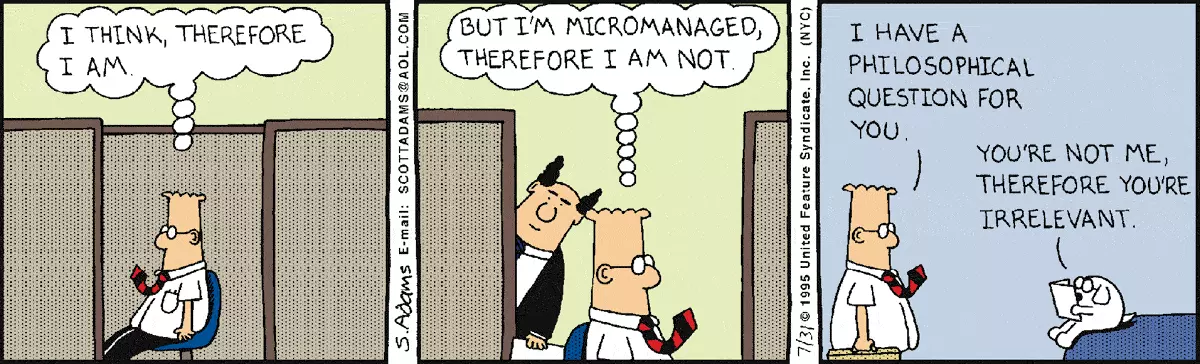
Dilbert sits in his cubicle and thinks to himself, "I think, therefore I am."
The Boss pokes his head into Dilbert's cubicle. Dilbert thinks, "But I'm micromanaged, therefore I am not."
Back at home, Dilbert says to Dogbert, "I have a philosophical question for you."
Dogbert replies, "You're not me, therefore you're irrelevant."
originally published on dilbert.com
Open source transcript
I THINK, THEREFORE I AM (BUT I'M MICROMANAGED, THEREFORE I AM NOT I HAVE A PHILOSOPHICAL QUESTION FOR YOU.
YOU'RE NOT ME, THEREFORE YOU'RE IRRELEVANT.
collated from github.com/jvarn/dilbert-archive
AI Analysis
Title: "Philosophical Quagmire"
This comic strip, originally published in July 1995, delves into the realm of philosophical inquiry, poking fun at the absurdities of abstract thought. The strip features Dilbert, a bespectacled office worker, engaged in a conversation with his colleague, Wally.
The Conversation
- Dilbert states, "I think, therefore I am."
- Wally responds with a tongue-in-cheek comment, "But I'm micromanaged, therefore I am not."
- Dilbert, taken aback, asks, "I have a philosophical question for you."
- Wally retorts, "You're not me, therefore you're irrelevant."
The Punchline
The strip's humor lies in its clever play on philosophical concepts, using them to highlight the absurdities of office politics and bureaucracy. The exchange between Dilbert and Wally serves as a commentary on the limitations of language and the dangers of getting lost in abstract thought.
Key Takeaways
- The comic strip uses philosophical concepts to comment on office politics and bureaucracy.
- The exchange between Dilbert and Wally highlights the limitations of language and the dangers of getting lost in abstract thought.
- The strip's humor is rooted in its clever play on philosophical ideas, making it a relatable and entertaining read for anyone familiar with the Dilbert series.
generated by llama-3.2-11b-vision-instruct
Accompanying textual content, such as title, tags and transcripts, is shown here if we have it. Not every comic has all of these, and they seem to be a bit hit and miss even on the official website.