Dilbert cartoon first published on Monday 6th May 1996
Dilbert//2578, first published thirty years ago on Monday 6th May 1996
Tags
wally compensation equalibrium project lower quality consistent salary first month after raises achieved equilibrium money
Official transcript
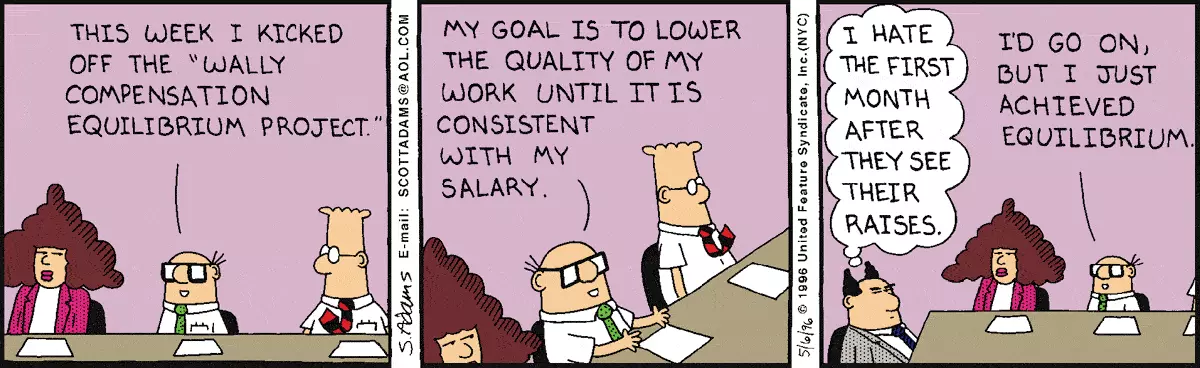
The Boss, Alice, Wally and Dilbert sit at a conference table. Wally says, "This week I kicked off the 'Wally Compensation Equilibrium Project.'"
Wally continues, "My goal is to lower the quality of my work until it is consistent with my salary."
The Boss thinks, "I hate the first month after they see their raises."
Wally says, "I'd go on, but I just achieved equilibrium."
originally published on dilbert.com
Open source transcript
THIS WEEK I KICKED OFF THE "WALLY COMPENSATION EQUILIBRIUM PROJECT." MY GOAL IS TO LOWER THE QUALITY OF MY WORK UNTIL IT IS CONSISTENT WITH MY SALARY.
I HATE THE FIRST MONTH AFTER THEY SEE THEIR RAISES.
I'D GO ON, BUT I JUST ACHIEVED EQUILIBRIUM
collated from github.com/jvarn/dilbert-archive
AI Analysis
The comic strip, originally published in 1996, is titled "Wally Compensation Equilibrium Project." The story follows Wally, an employee who has launched a project to lower the quality of his work until it is consistent with his salary. He believes that this will bring him into equilibrium with his coworkers, who have higher salaries despite their lower work quality.
Key Scenes and Dialogue
- Wally presents his project to the company, citing his goal of achieving equilibrium with his coworkers.
- His coworkers are skeptical and unimpressed, with one commenting, "I hate the first month after they see their raises."
- The strip ends with Wally looking frustrated and disappointed, suggesting that his plan may not be working as intended.
Themes and Commentary
- The comic strip pokes fun at the idea that people often try to justify their low performance by blaming others or circumstances beyond their control.
- It also highlights the absurdity of Wally's plan, which is unlikely to succeed in achieving his desired outcome.
- The strip uses humor to comment on the human tendency to try to find excuses for our own shortcomings, rather than taking responsibility for our actions.
generated by llama-3.2-11b-vision-instruct
Accompanying textual content, such as title, tags and transcripts, is shown here if we have it. Not every comic has all of these, and they seem to be a bit hit and miss even on the official website.


