Dilbert cartoon first published on Sunday 29th August 1999
Dilbert//3788, first published 27 years ago on Sunday 29th August 1999
Tags
last bullet point bullet point admit wrong alice heard wrong boss has to admit wrong
Official transcript
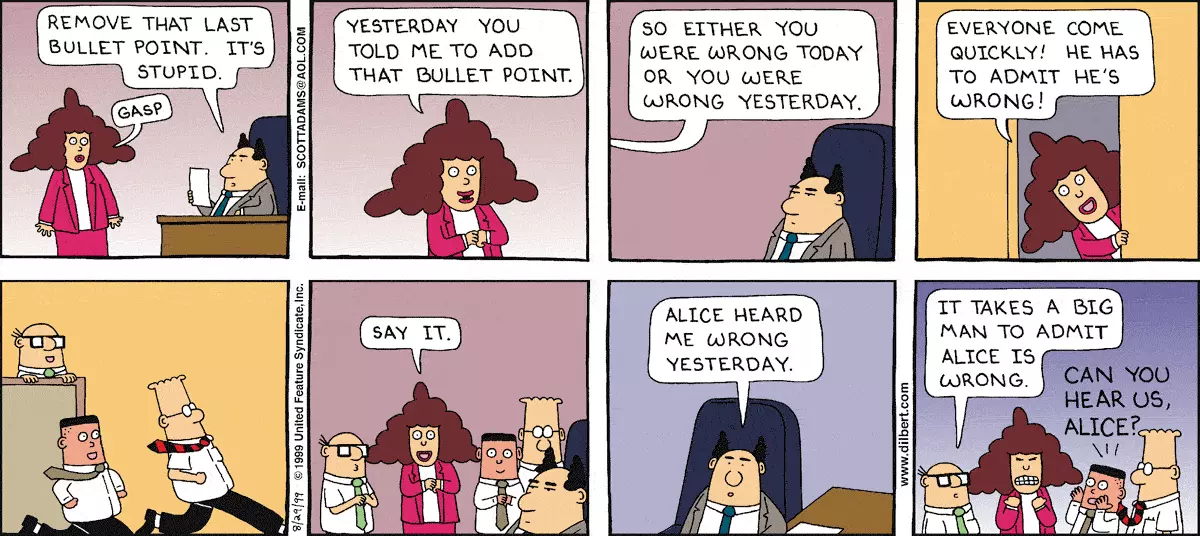
Alice has just presented a document to the Boss. As the Boss reads it, he tells her, "Remove that last bullet point. It's stupid."
Alice gasps. Alice crosses her arms and says, "Yesterday, you told me to add that bullet point."
She continues, "So either you were wrong today or you were wrong yesterday."
The Boss ponders this. Alice pokes her head out of the Boss' office to tell the other workers, "Everyone come quickly! He has to admit he's wrong!"
Dilbert and Asok sprint down the hall. Wally's head pops up from behind his cubicle wall, elated. Once the other employees are gathered around her, Alice cues the Boss, "Say it."
The Boss responds, "Alice heard me wrong yesterday."
Alice is furious as everyone continues to stand around her. Wally says, "It takes a big man to admit Alice is wrong."
Asok, cupping his hands to his mouth, yells, "Can you hear us Alice?"
originally published on dilbert.com
Open source transcript
REMOVE THAT LAST BULLET POINT. IT'S STUPID GASP YESTERDAY YOU TOLD ME TO ADD THAT BULLET POINT.
SO EITHER YOU WERE WRONG TODAY OR YOU WERE WRONG YESTERDAY.
EVERYONE COME QUICKLY! HE HAS TO ADMIT HE'S WRONG!
ALICE HEARD ME WRONG YESTERDAY.
IT TAKES A BIG MAN TO ADMIT ALICE IS WRONG.
CAN YOU HEAR US, ALICE?
collated from github.com/jvarn/dilbert-archive
AI Analysis
Title: "The Blame Game"
Summary:
This comic strip, originally published in 1999, is a humorous commentary on the corporate world's tendency to pass blame. The story revolves around a woman who is tasked with removing the last bullet point from a presentation. However, she mistakenly adds a new bullet point, which leads to a chain reaction of miscommunication and blame-shifting.
Key Scenes:
- The woman is reprimanded for adding a new bullet point, but she insists it was an accident.
- The boss asks her to admit she was wrong, but she refuses, claiming that someone else must have added the point.
- The boss then asks everyone in the room if they were wrong, and each person points to someone else.
- The woman is eventually blamed for the mistake, despite her protests of innocence.
Themes:
- The comic strip pokes fun at the corporate culture of passing blame and avoiding accountability.
- It highlights the absurdity of trying to assign blame in a situation where multiple people are involved.
- The strip also touches on the theme of communication breakdowns and the importance of clear and accurate information.
Tone:
- The comic strip is written in a lighthearted and humorous tone, with exaggerated characters and situations.
- The language is playful and satirical, with a touch of irony and sarcasm.
Overall:
- "The Blame Game" is a relatable and entertaining comic strip that offers a commentary on the quirks of corporate culture.
- It is a great example of the humor and wit that Dilbert is known for, and is sure to resonate with anyone who has ever worked in an office environment.
generated by llama-3.2-11b-vision-instruct
Accompanying textual content, such as title, tags and transcripts, is shown here if we have it. Not every comic has all of these, and they seem to be a bit hit and miss even on the official website.


