Dilbert cartoon first published on Sunday 23rd April 2017
Dilbert//10235, first published nine years ago on Sunday 23rd April 2017
Tags
failure, blame, executives, scapegoat
Official transcript
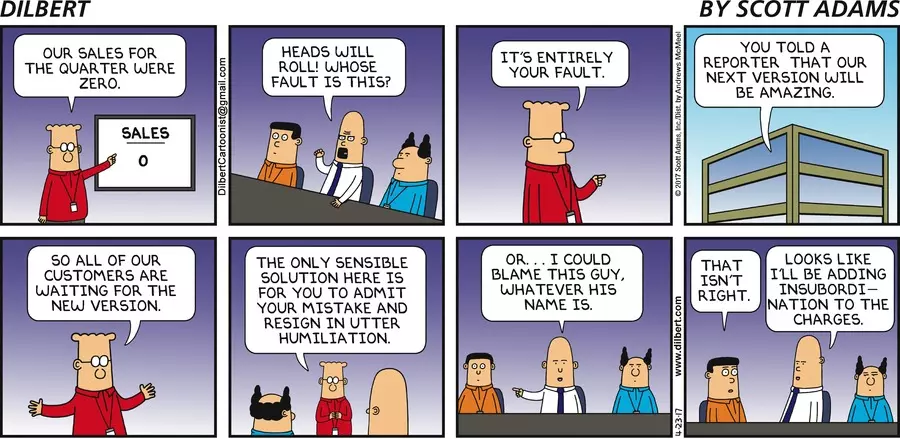
Dilbert: Our sales for the quarter were zero. CEO: Heads will roll! Whose fault is this. Dilbert: It's entirely your fault. You told a reporter that our next version will be amazing. So all of our customers are waiting for the new version. The only sensible solution here is for you to admit your mistake and resign in utter humiliation. CEO: Or... I could blame this guy, whatever his name is. Man: That isn't right. CEO: Looks like I'll be adding insubordination to the charges.
originally published on dilbert.com
Open source transcript
OUR SALES FOR THE QUARTER WERE ZERO.
SALES HEADS WILL ROLL! WHOSE FAULT IS THIS?
IT'S ENTIRELY YOUR FAULT.
YOU TOLD A REPORTER THAT OUR NEXT VERSION WILL BE AMAZING.
SO ALL OF OUR CUSTOMERS ARE WAITING FOR THE NEW VERSION.
THE ONLY SENSIBLE SOLUTION HERE IS FOR YOU TO ADMIT YOUR MISTAKE AND RESIGN IN UTTER HUMILIATION.
OR... I COULD BLAME THIS GUY, WHATEVER HIS NAME IS.
THAT ISN'T RIGHT.
LOOKS LIKE I'LL BE ADDING INSUBORDINATION TO THE CHARGES.
collated from github.com/jvarn/dilbert-archive
AI Analysis
Comic Strip Title: "The Blame Game"
Summary:
The comic strip, originally published in 2017, revolves around a workplace scenario where a sales team's performance is under scrutiny. The narrative unfolds as follows:
- The sales team's quarter-one performance is revealed to be zero, prompting a meeting to discuss the issue.
- The team's leader, Dilbert, takes responsibility for the failure, citing a single customer as the cause.
- However, when Dilbert is asked to name the customer, he becomes evasive and deflects blame onto others.
- The scene shifts to a boardroom meeting, where Dilbert's superiors are present.
- Dilbert's superiors express their disappointment with his lack of accountability and accuse him of making excuses.
- In response, Dilbert claims that he will be adding "subordination to charges" to the charges against him, implying that he will take responsibility for the failure.
- The comic strip concludes with a sense of irony, as Dilbert's superiors seem to be more concerned with appearances than actual accountability.
Key Themes:
- The comic strip explores the theme of accountability and responsibility in the workplace.
- It highlights the tendency for individuals to shift blame onto others rather than taking ownership of their mistakes.
- The strip also touches on the importance of transparency and honesty in leadership.
generated by llama-3.2-11b-vision-instruct
Accompanying textual content, such as title, tags and transcripts, is shown here if we have it. Not every comic has all of these, and they seem to be a bit hit and miss even on the official website.


