Dilbert cartoon first published on Thursday 25th June 2009
Dilbert//7376, first published seventeen years ago on Thursday 25th June 2009
Tags
lying reading taxes audit ridiculous costume
Official transcript
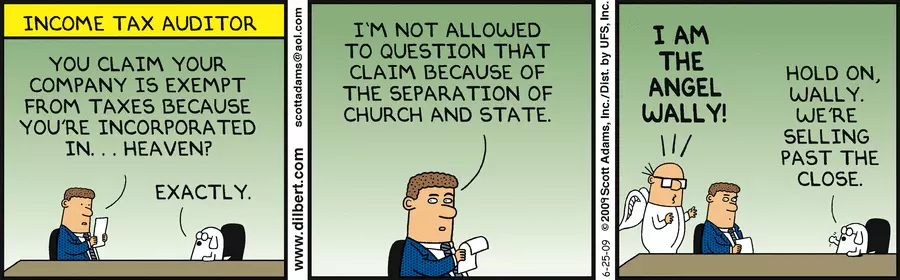
Income Tax Auditor Man says, "You claim your company is exempt from taxes because you're incorporated in?heaven?"
Dogbert says, "Exactly."
Man says, "I'm not allowed to question that claim because of the seperation between church and state."
Wally says, "I am the angel Wally!"
DOgbert says, "Hold on, Wally. We're selling past the close."
originally published on dilbert.com
Open source transcript
INCOME TAX AUDITOR YOU CLAIM YOUR COMPANY IS EXEMPT FROM TAXES BECAUSE YOU'RE INCORPORATED IN. . HEAVEN?
EXACTLY.
I'M NOT ALLOWED TO QUESTION THAT CLAIM BECAUSE OF THE SEPARATION OF CHURCH AND STATE.
I AM THE ANGEL WALLY!
HOLD ON, WALLY.
WERE SELLING PAST THE CLOSE.
collated from github.com/jvarn/dilbert-archive
AI Analysis
Title: "Taxing the Divine"
Summary:
This comic strip, originally published in 2004, features Dilbert and Wally in a humorous exchange with an income tax auditor. The conversation revolves around the company's tax-exempt status, with the auditor questioning the claim due to the separation of church and state.
Key Points:
- Dilbert's company claims to be exempt from taxes because it is incorporated in heaven.
- The auditor is skeptical, citing the separation of church and state.
- Dilbert responds by stating that he is not allowed to question the claim because of the separation of church and state.
- Wally, dressed as an angel, intervenes and claims that the company is selling past the close, implying that the company is making a profit and therefore not exempt from taxes.
- The auditor is left confused and frustrated, while Dilbert and Wally share a knowing glance.
Humor:
The comic strip relies on wordplay and absurdity to create humor. The use of the phrase "selling past the close" is a clever pun, as it is a common term used in finance to describe the act of selling securities after the market has closed. In this context, Wally's use of the phrase implies that the company is making a profit, which would not be allowed if it were truly exempt from taxes. The image of Wally dressed as an angel adds to the comedic effect, as it is a unexpected and humorous twist on the typical depiction of angels. Overall, the comic strip uses clever writing and clever visuals to create a humorous and entertaining story.
generated by llama-3.2-11b-vision-instruct
Accompanying textual content, such as title, tags and transcripts, is shown here if we have it. Not every comic has all of these, and they seem to be a bit hit and miss even on the official website.


