Dilbert cartoon first published on Sunday 15th August 2010
Dilbert//7792, first published sixteen years ago on Sunday 15th August 2010
Tags
meeting small groups argue alone talk to self annoyed empty chairs business
Official transcript
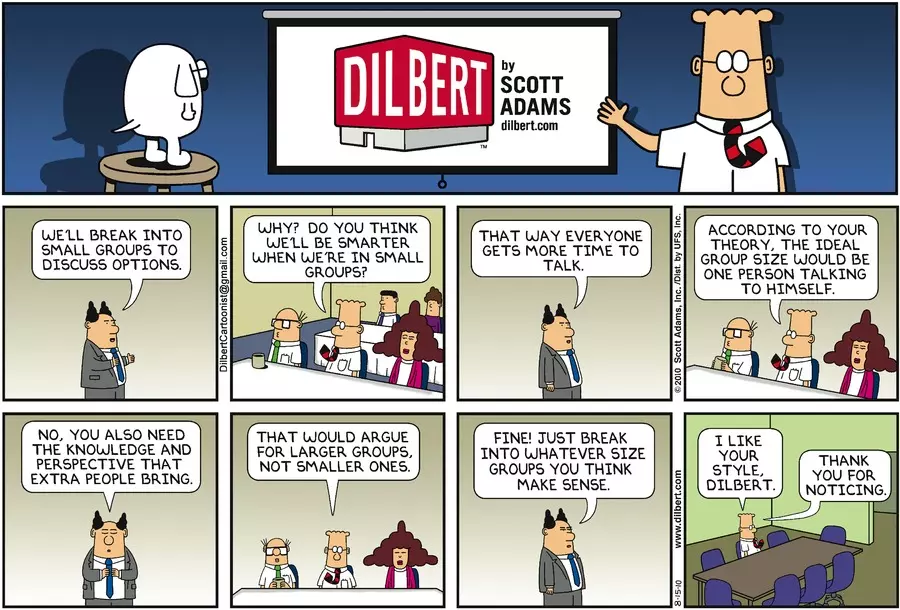
The Boss says, "We'll break into small groups to discuss options."
Dilbert says, "Why? Do you think we'll be smarter when we're in small groups?"
The Boss says, "That way everyone gets more time to talk."
Dilbert says, "According to your theory, the ideal group size would be one person talking to himself."
The Boss says, "No, you also need the knowledge and perspective that extra people bring."
Dilbert says, "That would argue for larger groups, not smaller ones."
The Boss says, "Fine! Just break into whatever size groups you think make sense."
Dilbert says, "I like your style, Dilbert."
Dilbert says, "Thank you for noticing."
originally published on dilbert.com
Open source transcript
WELL BREAK INTO SMALL GROUPS TO DISCUSS OPTIONS.
DILBERT SCOTT ADAMS dilbert.com WHY? DO YOU THINK WELL BE SMARTER WHEN WE'RE IN SMALL GROUPS?
THAT WAY EVERYONE GETS MORE TIME TO TALK.
ACCORDING TO YOUR THEORY, THE IDEAL GROUP SIZE WOULD BE ONE PERSON TALKING TO HIMSELF.
NO, YOU ALSO NEED THE KNOWLEDGE AND PERSPECTIVE THAT EXTRA PEOPLE BRING.
THAT WOULD ARGUE FOR LARGER GROUPS, NOT SMALLER ONES.
FINE! JUST BREAK INTO WHATEVER SIZE GROUPS YOU THINK MAKE SENSE.
I LIKE YOUR STYLE, DILBERT.
THANK YOU FOR NOTICING.
collated from github.com/jvarn/dilbert-archive
AI Analysis
The comic strip is titled "Group Size" and features Dilbert, a bespectacled, balding man with a distinctive appearance, in a meeting room. The strip consists of nine panels, each with a caption and speech bubbles.
Panel 1: A whiteboard displays the company logo, "DILBERT by SCOTT ADAMS," and the website "dilbert.com." A man, likely the boss, stands beside it, gesturing to the board.
Panel 2-3: Dilbert addresses the group, saying, "We'll break into small groups to discuss options." The boss responds, "Why? Do you think we'll be smarter when we're in small groups?"
Panel 4: The boss asks, "That way everyone gets more time to talk." Dilbert replies, "According to your theory, the ideal group size would be one person talking to himself."
Panel 5: The boss says, "No, you also need the knowledge and perspective that extra people bring." Dilbert responds, "That would argue for larger groups, not smaller ones."
Panel 6: The boss says, "Fine, just break into whatever size groups you think make sense." Dilbert replies, "I like your style, Dilbert. Thank you for noticing."
Panel 7-9: The boss thanks Dilbert for noticing his style, and the meeting ends with the group members discussing their ideas in small groups.
Summary: The comic strip satirizes the common practice of breaking into small groups to facilitate discussion and decision-making. The boss's illogical reasoning and Dilbert's sarcastic responses highlight the absurdity of this approach. The strip pokes fun at the idea that smaller groups are inherently more effective, and instead suggests that larger groups can provide more diverse perspectives and knowledge. Overall, the comic strip uses humor to comment on the flaws in group dynamics and the importance of critical thinking.
generated by llama-3.2-11b-vision-instruct
Accompanying textual content, such as title, tags and transcripts, is shown here if we have it. Not every comic has all of these, and they seem to be a bit hit and miss even on the official website.


