Dilbert cartoon first published on Sunday 5th April 2015
Dilbert//9486, first published 11 years ago on Sunday 5th April 2015
Tags
work ethic, work, google, big business, projects, ideas, innovation
Official transcript
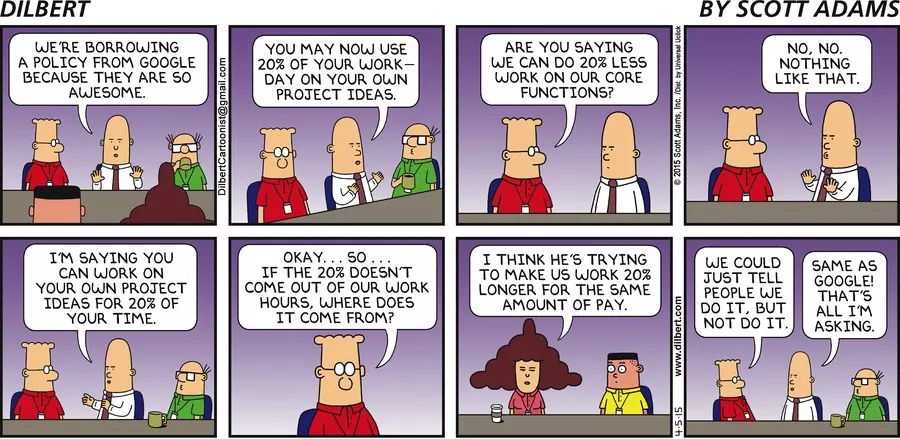
CEO: We're borrowing a policy from Google because they are so awesome. You may now use 20% of your workday on your own project ideas. Dilbert: Are you saying we can do 20% less work on our core functions? CEO: No, no. Nothing like that. I'm saying you can work on your own project ideas for 20% of your time. Dilbert: Okay... so... if the 20% doesn't come out of our work hours, where does it come from? Alice: I think he's trying to make us work 20% longer for the same amount of pay. Dilbert; We could just tell people we do it, but not do it. CEO: Same as Google! That's all I'm asking.
originally published on dilbert.com
Open source transcript
WE'RE BORROWING A POLICY FROM GOOGLE BECAUSE THEY ARE SO AWESOME.
YOU MAY NOW USE 20% OF YOUR WORKDAY ON YOUR OWN PROJECT IDEAS.
ARE YOU SAYING WE CAN DO 20% LESS WORK ON OUR CORE FUNCTIONS?
NO, NO.
NOTHING LIKE THAT.
IM SAYING YOU CAN WORK ON YOUR OWN PROJECT IDEAS FOR 20% OF YOUR TIME.
OKAY... 50 ...
IF THE 20% DOESN'T COME OUT OF OUR WORK HOURS, WHERE DOES IT COME FROM?
I THINK HE'S TRYING TO MAKE US WORK 20% LONGER FOR THE SAME AMOUNT OF PAY.
WE COULD JUST TELL PEOPLE WE DO IT, BUT NOT DO IT.
SAME AS GOOGLE!
THAT'S ALL I'M ASKING.
collated from github.com/jvarn/dilbert-archive
AI Analysis
Title: "The 20% Rule"
Summary:
The comic strip revolves around a company's policy of allowing employees to dedicate 20% of their workday to personal projects. The conversation begins with a manager announcing this policy, which is met with skepticism by Dilbert and his coworkers.
- Dilbert's Concerns: Dilbert questions the feasibility of implementing the policy, citing the manager's lack of clarity on how it will work.
- Manager's Response: The manager responds by stating that the 20% rule is in place to foster innovation and creativity, but he is unsure how it will be enforced.
- Employee Resistance: The employees express their concerns about the policy, including the potential impact on their workload and the lack of clear guidelines.
- Manager's Rebuttal: The manager defends the policy, arguing that it will lead to increased productivity and innovation.
- Conclusion: The comic strip ends with the employees still expressing skepticism about the policy, while the manager remains committed to its implementation.
Overall, the comic strip highlights the challenges of implementing new policies in the workplace and the importance of clear communication and guidelines.
generated by llama-3.2-11b-vision-instruct
Accompanying textual content, such as title, tags and transcripts, is shown here if we have it. Not every comic has all of these, and they seem to be a bit hit and miss even on the official website.


