Dilbert cartoon first published on Sunday 22nd April 2018
Dilbert//10599, first published eight years ago on Sunday 22nd April 2018
Tags
memory, demagoguery, social media, opinion, technology
Official transcript
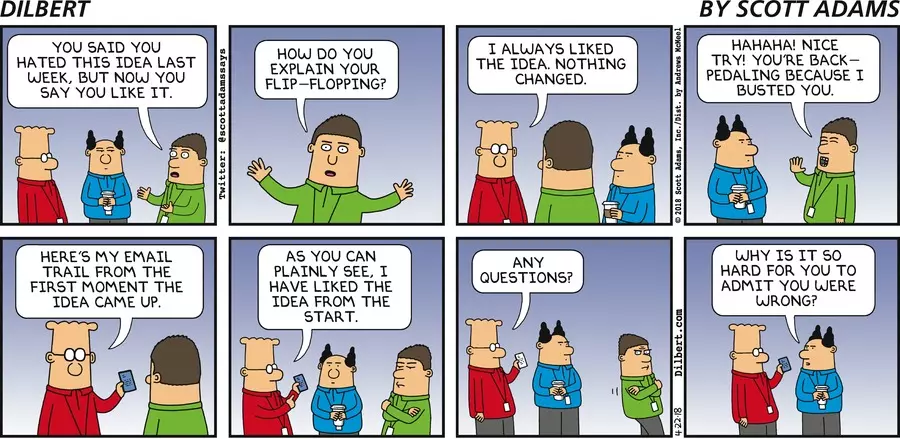
Man: You said you hated this idea last week, but now you say you like it. How do you explain your flip-flopping? Dilbert: I always liked the idea. Nothing changed. Man: Hahaha! Nice try! You're back-pedaling because I busted you. Dilbert: Here is my email trail from the first moment the idea came up. As you can plainly see, I have liked the idea from the start. Any questions? Boss: Why is it so hard for you to admit you were wrong?
originally published on dilbert.com
Open source transcript
YOU SAID YOU HATED THIS IDEA LAST WEEK, BUT NOW YOU SAY YOU LIKE IT.
HOW DO YOU EXPLAIN YOUR FLIP-FLOPPING?
I ALWAYS LIKED THE IDEA. NOTHING CHANGED.
HAHAHA! NICE TRY! YOU'RE BACK PEDALING BECAUSE I BUSTED YOU.
HERE'S MY EMAIL TRAIL FROM THE FIRST MOMENT THE IDEA CAME UP.
AS YOU CAN PLAINLY SEE, I HAVE LIKED THE IDEA FROM THE START.
ANY QUESTIONS?
WHY IS IT SO HARD FOR YOU TO ADMIT YOU WERE WRONG?
collated from github.com/jvarn/dilbert-archive
AI Analysis
Title: "The Cycle of Innovation"
Summary:
The comic strip, created by Scott Adams, humorously illustrates the challenges of introducing new ideas in a workplace setting. The story revolves around a character named Dilbert, who presents an innovative concept to his colleagues. However, instead of receiving constructive feedback, he faces resistance and criticism.
Key Points:
- Dilbert introduces his idea, which he believes will revolutionize the company.
- His colleagues respond with skepticism and criticism, questioning the practicality and feasibility of the concept.
- Despite Dilbert's efforts to explain and defend his idea, his colleagues remain unconvinced.
- The cycle of innovation is depicted as a never-ending process, where new ideas are constantly met with resistance and criticism.
Humor and Satire:
The comic strip uses satire to poke fun at the common phenomenon of employees being hesitant to adopt new ideas. The humor lies in the exaggerated reactions of Dilbert's colleagues, who are portrayed as being overly critical and close-minded. The strip also highlights the importance of effective communication and the need for open-mindedness when introducing new ideas in a workplace setting.
generated by llama-3.2-11b-vision-instruct
Accompanying textual content, such as title, tags and transcripts, is shown here if we have it. Not every comic has all of these, and they seem to be a bit hit and miss even on the official website.