Dilbert cartoon first published on Sunday 3rd December 2006
Dilbert//6441, first published twenty years ago on Sunday 3rd December 2006
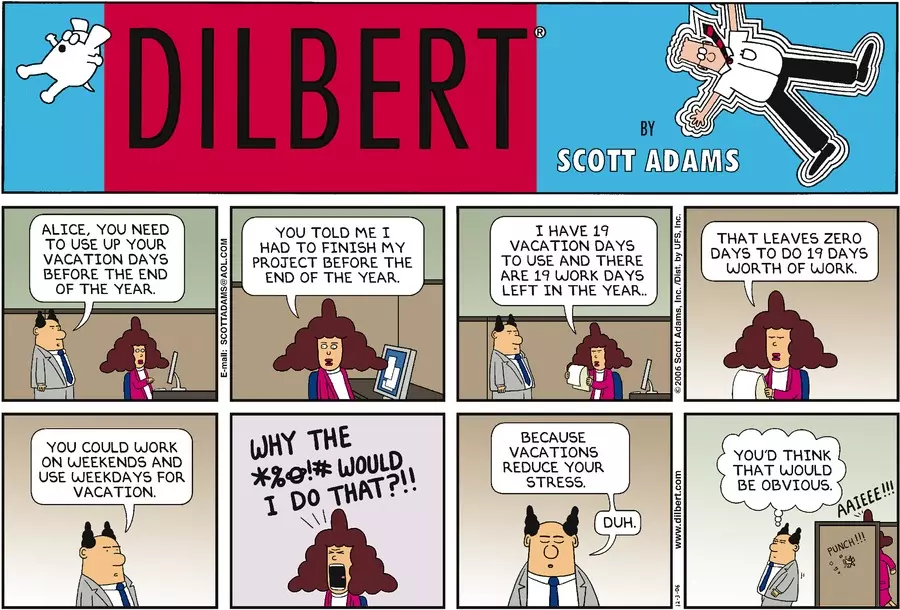
Official transcript
"Alice, you need to use up your vacation days before the end of the year."
"You told me I had to finish my project before the end of the year."
"I have 19 vacation days to use and there are 19 work days left in the year."
"That leaves zero days to do 19 days worth of work."
"You could work on weekends and use weekdays for vacation."
"Why the @#$% would I do that?!!"
"Because vacations reduce your stress. Duh."
"You'd think that would be obvious."
"AAIEEE!!!"
PUNCH!!!
originally published on dilbert.com
Open source transcript
ALICE, YOU NEED TO USE UP YOUR VACATION DAYS BEFORE THE END OF THE YEAR.
YOU TOLD ME I HAD TO FINISH MY PROJECT BEFORE THE END OF THE YEAR.
I HAVE 19 VACATION DAYS TO USE AND THERE ARE 19 WORK DAYS LEFT IN THE YEAR..
THAT LEAVES ZERO DAYS TO DO 19 DAYS WORTH OF WORK.
YOU COULD WORK ON WEEKENDS AND USE WEEKDAYS FOR VACATION.
WHY THE *%0!* WOULD I DO THAT?!!
BECAUSE VACATIONS REDUCE YOUR STRESS.
YOU'D THINK THAT WOULD BE OBVIOUS.
AAIEEE.!!!
PUNCH!!!
collated from github.com/jvarn/dilbert-archive
AI Analysis
Comic Strip Title: "Vacation Days"
Summary:
The comic strip, originally published in 2004, revolves around the theme of vacation days. The story begins with Alice informing her boss, Dilbert, that she has 19 vacation days left in the year. Dilbert responds by telling her that she needs to use up her vacation days before the end of the year. Alice explains that she had to finish her project before the end of the year, and as a result, she has used up all her vacation days.
Dilbert then reveals that he has 19 vacation days to use and there are only 19 workdays left in the year. He suggests that Alice use her weekends and weekdays for vacation, which she finds amusing. However, Dilbert's reasoning is that by doing so, she would reduce her stress levels.
Alice is perplexed by Dilbert's logic and responds with a sarcastic comment, implying that he is not thinking clearly. The comic strip ends with Dilbert's response, "You'd think that would be obvious." The humor in the strip lies in the absurdity of Dilbert's suggestion and the exchange between the two characters.
generated by llama-3.2-11b-vision-instruct
Accompanying textual content, such as title, tags and transcripts, is shown here if we have it. Not every comic has all of these, and they seem to be a bit hit and miss even on the official website.


