Dilbert cartoon first published on Sunday 4th May 2008
Dilbert//6959, first published eighteen years ago on Sunday 4th May 2008
Tags
lead developer project setting up for failure gets cancelled motions hoping for cancellation
Official transcript
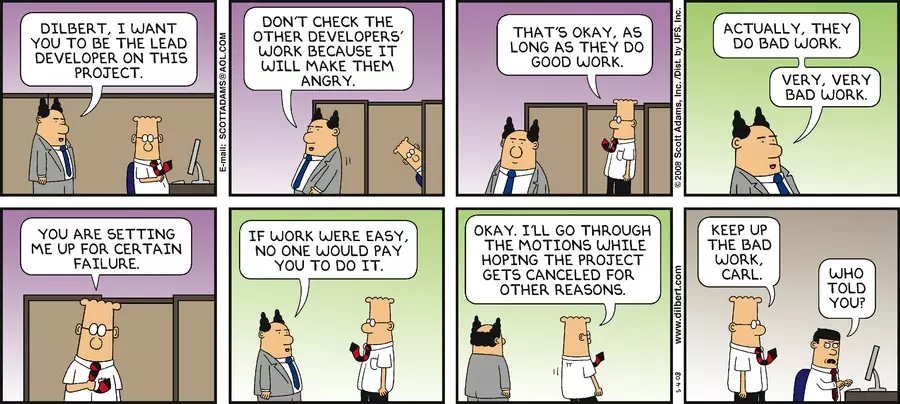
The Boss says, "Dilbert, I want you to the be lead developer on this project."
The Boss says, "Don't check the other developers' work because it will make them angry."
Dilbert says, "That's okay, as long as they do good work."
The Boss says, "Actually, they do bad work. Very, very bad work."
Dilbert says, "You are setting me up for certain failure."
The Boss says, "If work were easy, no one would pay you to do it."
Dilbert says, "Okay. I'll go through the motions while hoping the project gets canceled for other reasons."
Dilbert says, "Keep up the bad work, Carl."
Carl says, "Who told you?"
originally published on dilbert.com
Open source transcript
, I WANT YOU TO BE THE LEAD DEVELOPER ON THIS PROJECT.
DON'T CHECK THE OTHER DEVELOPERS' WORK BECAUSE IT WILL MAKE THEM ANGRY.
THAT'S OKAY, AS LONG AS THEY DO GOOD WORK.
ACTUALLY, THEY DO BAD WORK.
VERY, VERY BAD WORK.
YOU ARE SETTING ME UP FOR CERTAIN FAILURE.
IF WORK WERE EASY, NO ONE WOULD PAY YOU TO DO IT.
OKAY. I'LL GO THROUGH THE MOTIONS WHILE HOPING THE PROJECT GETS CANCELED FOR OTHER REASONS.
KEEP UP THE BAD WORK, CARL.
WHO TOLD YOU?
collated from github.com/jvarn/dilbert-archive
AI Analysis
The title of this comic strip is "Bad Work".
This comic strip depicts a conversation between Dilbert, the lead developer, and Carl, his boss. Dilbert is tasked with checking the work of other developers, but he is frustrated by the fact that they do bad work. He expresses his concerns to Carl, who tells him that it's okay as long as they do good work. Dilbert is skeptical, but Carl reassures him that it's fine.
The conversation takes a turn when Dilbert mentions that he'll go through the motions while hoping the project gets canceled for other reasons. Carl responds by asking who told him that, implying that Dilbert is not supposed to know about the project's fate.
Overall, the comic strip pokes fun at the bureaucratic nature of corporate culture, where employees are often expected to follow procedures without questioning the outcome. It also highlights the tension between Dilbert's desire to do good work and the reality of working in a system that values efficiency over quality.
generated by llama-3.2-11b-vision-instruct
Accompanying textual content, such as title, tags and transcripts, is shown here if we have it. Not every comic has all of these, and they seem to be a bit hit and miss even on the official website.


