Dilbert cartoon first published on Sunday 8th July 2012
Dilbert//8485, first published fourteen years ago on Sunday 8th July 2012
Tags
brainstorm discussion less effective meetings new product ideas stem cell technology
Official transcript
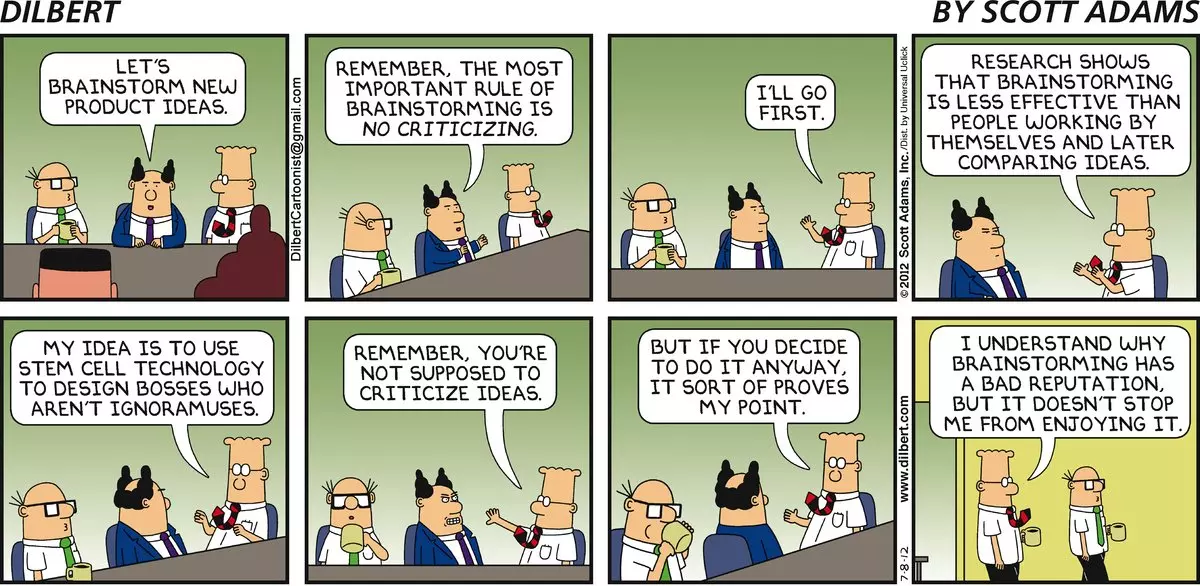
Boss: Let's brainstorm new product ideas. Remember, the most important rule of brainstorming is no criticizing. Dilbert: I'll go first. Research shows that brainstorming is less effective than people working by themselves and later comparing ideas. My idea is to use stem cell technology to design bosses who aren't ignoramuses. Remember, you're not supposed to criticize ideas. But if you decide to do it anyway, it sort of proves my point. I understand whey brainstorming has a bad reputation, but it doesn't stop me from enjoying it.
originally published on dilbert.com
Open source transcript
LET'S BRAINSTORM NEW PRODUCT IDEAS.
REMEMBER, THE MOST IMPORTANT RULE OF BRAINSTORMING IS NO CRITICIZING.
I'LL GO FIRST.
RESEARCH SHOWS THAT BRAINSTORMING IS LESS EFFECTIVE THAN PEOPLE WORKING BY THEMSELVES AND LATER COMPARING IDEAS.
MY IDEA IS TO USE STEM CELL TECHNOLOGY TO DESIGN BOSSES WHO AREN'T IGNORAMUSES.
REMEMBER, YOU'RE NOT SUPPOSED TO CRITICIZE IDEAS.
BUT IF YOU DECIDE TO DO IT ANYWAY, IT SORT OF PROVES MY POINT.
I UNDERSTAND WHY BRAINSTORMING HAS A BAD REPUTATION, BUT IT DOESN'T STOP ME FROM ENJOYING IT.
collated from github.com/jvarn/dilbert-archive
AI Analysis
Comic Strip Title: "The Art of Criticism"
Summary:
The comic strip, originally published in 2012, revolves around the theme of brainstorming and criticism. It features Dilbert, a bespectacled engineer, and his coworkers engaging in a meeting to generate new product ideas.
Key Scenes:
- Brainstorming Session: The meeting commences with Dilbert's suggestion to brainstorm new product ideas. His coworkers enthusiastically participate, but their ideas are met with criticism from the boss, who is portrayed as a balding man with a scowl.
- Importance of Criticism: The boss emphasizes that criticism is essential for innovation, citing research that suggests it leads to better ideas. However, he also warns against over-criticism, which can stifle creativity.
- Stem Cell Technology: Dilbert proposes using stem cell technology to design bosses who aren't ignorant or amuses. This idea is met with skepticism, but the boss encourages him to continue exploring it.
- Decision-Making: Dilbert decides to proceed with his idea, despite the boss's initial reservations. The boss agrees to support him, but only if he can prove the concept works.
- Conclusion: The comic strip concludes with Dilbert reflecting on the importance of criticism in the brainstorming process. He acknowledges that it can be challenging to receive feedback, but ultimately believes that it leads to better ideas.
Overall: The comic strip highlights the delicate balance between constructive criticism and creative freedom. While criticism is necessary for innovation, it must be delivered in a way that encourages growth and exploration, rather than stifling creativity.
generated by llama-3.2-11b-vision-instruct
Accompanying textual content, such as title, tags and transcripts, is shown here if we have it. Not every comic has all of these, and they seem to be a bit hit and miss even on the official website.


