Dilbert cartoon first published on Sunday 13th July 2014
Dilbert//9220, first published twelve years ago on Sunday 13th July 2014
Tags
big business, business ethics, obliviousness, core competencies, automating things, worshipping stars quo, steve jobs, reanimated body, making lapses, fiduciary responsibility, hearing what we want
Official transcript
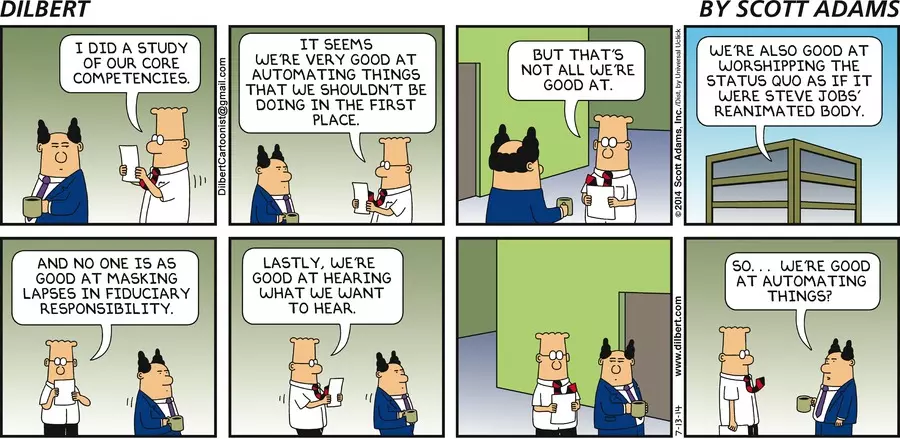
Dilbert: I did a study of our core competencies. It seems we're very good at automating things that we shouldn't be doing in the first place. But that's not all we're good at. We're also good at worshipping the status quo as if it were Steve Jobs' reanimated body. And no one is as good at masking lapses in fiduciary responsibility. Lastly, we're good at hearing what we want to hear. Boss: So... we're good at automating things?
originally published on dilbert.com
Open source transcript
I DID A STUDY OF OUR CORE COMPETENCIES IT SEEMS WE'RE VERY GOOD AT AUTOMATING THINGS THAT WE SHOULDN'T BE DOING IN THE FIRST PLACE.
BUT THAT'S NOT ALL WE'RE GOOD AT.
WE'RE ALSO GOOD AT WORSHIPPING THE STATUS QUO AS IF IT WERE STEVE JOBS' REANIMA TED BODY.
AND NO ONE IS AS GOOD AT MASKING LAPSES IN FIDUCIARY RESPONSIBILITY.
LASTLY, WE'RE GOOD AT HEARING WHAT WE WANT TO HEAR.
SO.
.. WE'RE GOOD AT AUTOMATING THINGS?
collated from github.com/jvarn/dilbert-archive
AI Analysis
Title: "Worshipping the Status Quo"
Summary:
The comic strip, originally published in, features Dilbert and his boss discussing core competencies. The conversation begins with Dilbert's study on core competencies, which reveals that no one is good at masking lapses in fiduciary responsibility. The boss responds that they are very good at automating things and worshipping the status quo as if it were Steve Jobs' reanimated body.
The comic strip highlights the irony of companies valuing efficiency and automation over accountability and responsibility. It pokes fun at the idea that companies prioritize maintaining the status quo over making meaningful changes. The strip also touches on the theme of corporate culture and the tendency for companies to prioritize image over substance. Overall, the comic strip uses humor to comment on the flaws in modern corporate culture.
generated by llama-3.2-11b-vision-instruct
Accompanying textual content, such as title, tags and transcripts, is shown here if we have it. Not every comic has all of these, and they seem to be a bit hit and miss even on the official website.


